
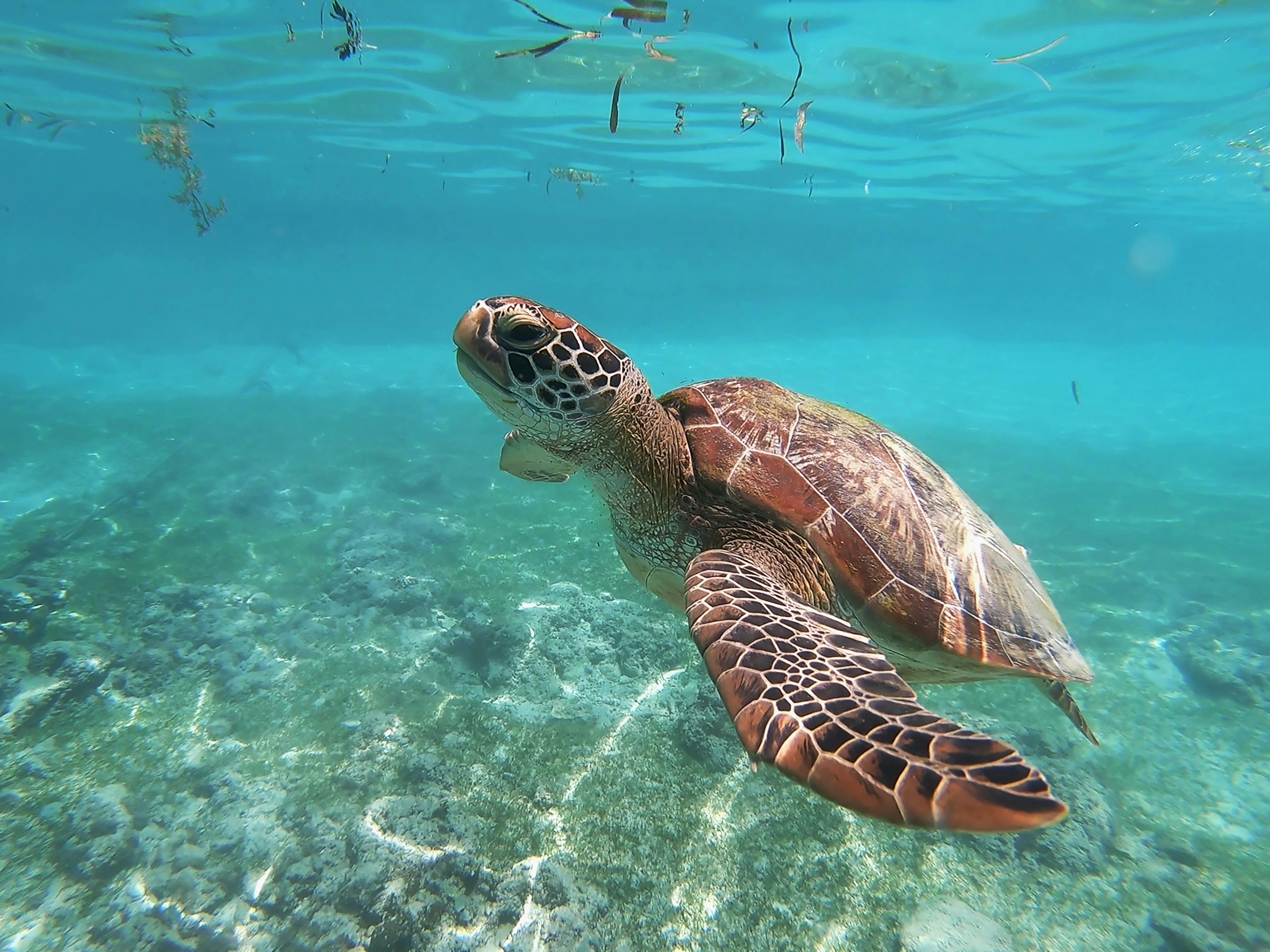
There are few experiences in nature as quietly overwhelming as watching a sea turtle nest. On a dark beach, under red light, a creature whose ancestors swam alongside the dinosaurs hauls herself out of the surf, digs a chamber in the sand with her back flippers, and lays a hundred eggs — then turns and disappears back into the ocean, never to see her young. Two months later, on a moonlit night, those eggs erupt into a scramble of tiny hatchlings racing for the waves. The astonishing, humbling part: of those hundred, perhaps one will live to return as an adult. And here’s what makes this more than a travel curiosity for guests at Vista Bendita — one of Costa Rica’s dedicated turtle reserves sits right here in Ojochal. This is the full story of Costa Rica’s sea turtles: ancient, endangered, and closer than you think.
Ancient Mariners: A Little History & Ecology
Sea turtles are among the most ancient animals on Earth, having navigated the oceans for over 100 million years — they genuinely shared the planet with the dinosaurs and outlived them. Costa Rica is one of the most important sea-turtle countries in the world, with nesting beaches on both its Pacific and Caribbean coasts and four species that nest regularly:
- Olive Ridley (Lepidochelys olivacea, locally “Lora”): The most abundant sea turtle in the world and the star of Costa Rica’s Pacific coast — including the beaches around Ojochal. Famous for the arribada, a mass synchronized nesting event where tens of thousands of females come ashore together (at Ostional and Nancite in the northwest).
- Green (Chelonia mydas): Named for the color of its body fat, not its shell. Largely herbivorous, grazing seagrass and algae. Costa Rica’s Caribbean Tortuguero is one of the most important green-turtle rookeries in the Western Hemisphere.
- Leatherback (Dermochelys coriacea): The giant — the largest sea turtle and one of the largest reptiles alive, reaching well over 600 kg, with a soft, leathery shell instead of a hard one. A deep-diving jellyfish specialist.
- Hawksbill (Eretmochelys imbricata): Recognizable by its hawk-like beak and beautiful shell. A reef specialist that eats sponges, helping keep coral reefs healthy.
Every one of these species is threatened or endangered. And each plays a distinct role in keeping the ocean healthy: leatherbacks control jellyfish populations, greens maintain seagrass meadows, and hawksbills protect coral reefs by grazing sponges. Lose the turtles and the whole system frays.
The Miracle and Gauntlet of Laying an Egg
The nesting process is one of nature’s most remarkable rituals. After mating at sea, a female sea turtle performs a feat of navigation that still astonishes scientists: natal homing. Using the Earth’s magnetic field like an internal GPS, she returns — often after decades and across thousands of miles of open ocean — to nest on or very near the same beach where she herself hatched.
Then comes the labor. Hauling her heavy body up the sand under cover of darkness, she:
- Digs a body pit and then a deeper, flask-shaped egg chamber using her rear flippers with surprising precision.
- Lays her clutch — typically 80 to 120 soft, leathery eggs for an olive ridley (more for a leatherback), often appearing to weep as she does, a result of glands shedding salt, not emotion.
- Camouflages the nest, covering and disguising it with sand to hide it from predators.
- Returns to the sea, leaving the eggs entirely on their own. There is no parental care — from this moment, the hatchlings rely on nothing but instinct and luck.
A female may lay several clutches in a single season (typically spaced about two weeks apart), but only nests once every two to four years, conserving energy in between.
Incubation, Hatching & the Race to the Sea
The eggs incubate for roughly 6 to 8 weeks, warmed only by the sand. Here lies one of the most fascinating — and now most worrying — facts about sea turtles: their sex is determined by temperature. Warmer sand produces females; cooler sand produces males. (Conservationists use the rhyme “hot chicks, cool dudes.”) As global temperatures rise, this is skewing hatchling populations dramatically toward females, a serious long-term threat.
When they’re ready, the hatchlings break out of their shells and dig upward together — a coordinated effort that can take days. They typically emerge at night, when the sand is cooler and predators fewer, then orient toward the brightest horizon (naturally the moonlit ocean) and make a frantic dash across the open beach. This “crawl” is the first and one of the most dangerous moments of their lives.
The Odds: One in a Thousand
Here is the sobering heart of the story. The widely cited estimate is that only about 1 in 1,000 sea turtle hatchlings survives to adulthood. (Scientists debate the exact figure — some recent modeling suggests it may be closer to 1 in 400 for the math of population replacement to work — but by any measure, the odds are brutally low.)
Why so few? The gauntlet is relentless:
- On the beach: crabs, birds, raccoons, and other predators pick off hatchlings during the crawl. Bigger, faster hatchlings that reach the water sooner survive at higher rates.
- In the surf and shallows: fish and seabirds wait where the hatchlings enter the water during their exhausting “swim frenzy.”
- The “lost years”: Those that survive drift into the open ocean for a period so mysterious that scientists call it the lost years — juveniles riding currents and sheltering in floating seaweed, largely untracked, for years before reappearing in coastal feeding grounds.
- The long road to maturity: Sea turtles grow slowly and don’t reproduce until they’re 10 to 50 years old, depending on species — meaning every adult is a decades-long survivor against the odds.
Modern, human-caused threats stack on top of the natural ones: poaching of eggs, plastic pollution, accidental capture in fishing gear (bycatch), coastal development, light pollution that disorients hatchlings, and climate change. It’s why conservation matters so much — small human interventions can dramatically shift those terrible odds.
Where Do They Go? The Great Migration
Between nesting seasons, adult sea turtles undertake some of the longest migrations of any animal, traveling hundreds to thousands of kilometers between their nesting beaches and their feeding grounds. A turtle that nests in Costa Rica may spend its non-nesting years foraging far out in the Pacific or along distant coastlines, then navigate all the way back to its home beach to reproduce. They are true ocean wanderers, tied to the Costa Rican coast by the single most powerful instinct in their lives: the need to return home to nest.
What Costa Rica Is Doing to Help
Costa Rica is widely regarded as a global leader in sea-turtle conservation, combining law, protected areas, and grassroots community action:
- Protected nesting beaches and national parks — from Tortuguero on the Caribbean to Ostional and Marino Ballena on the Pacific — safeguard critical habitat.
- Hatcheries and nest relocation: Conservation teams patrol beaches, find new nests, and relocate vulnerable eggs to protected hatcheries safe from poachers, tides, and predators — then release the hatchlings.
- Community-based science: Many projects were founded by local Costa Rican scientists and community members specifically to build a culture of conservation, blending research with hands-on protection.
- The Ostional model: At Ostional, Costa Rica created a unique legal program allowing the local community to sustainably and legally harvest a small, regulated number of eggs from the earliest hours of an arribada (eggs that would likely be destroyed by later nesting turtles anyway) — turning the community into invested protectors of the turtles rather than poachers. It’s a globally studied example of conservation that works with local people.
Turtles Right Here: Reserva Playa Tortuga in Ojochal
You don’t have to travel far to be part of this. Reserva Playa Tortuga (RPT), a non-profit biological research and education center, operates a sea-turtle conservation program right in Ojochal. Founded by community members and Costa Rican scientists, it protects primarily olive ridley nests (with green, leatherback, and hawksbill turtles occasionally appearing) on the local beaches. In recent seasons the program has protected well over a hundred nests and released thousands of hatchlings, and over its lifetime tens of thousands of baby turtles have made it to the sea because of work like this. Beyond turtles, RPT runs research on crocodilians, mammals, birds, and coral — a genuine window into the South Pacific’s biodiversity.
Turtle Season & When to See Them
On the Pacific coast around Ojochal, the key species is the olive ridley, and the rhythm of the year is:
- Nesting season: Roughly July to December, with the peak in September and October. During the peak, it’s often possible to witness a turtle nesting every other night — sometimes two or three.
- Hatching season: Roughly August into January/February, as each season’s nests incubate and emerge.
- Other species (regionally): Leatherbacks nest on the Pacific roughly October–March; greens and hawksbills have their own overlapping windows.
If your stay falls in the fall months, you have a real chance to witness one of nature’s great spectacles just minutes from the house.
How to Volunteer or Help
This is one of the most meaningful things a visitor can do on this coast, and it’s genuinely accessible:
- Volunteer with Reserva Playa Tortuga (Ojochal). RPT welcomes volunteers into its conservation program — joining night beach patrols to find nesting turtles, relocating eggs to the protected hatchery, collecting scientific data, and releasing hatchlings. Programs range from short stays to longer internships. Visit reservaplayatortuga.org to learn about current opportunities.
- Join a guided turtle tour in season — a responsible, low-impact way to witness nesting with an expert who ensures the turtles aren’t disturbed (no white lights, no flash, keep your distance).
- Donate. If you can’t volunteer, conservation projects like RPT run on donations to fund patrols, hatcheries, and research.
- Help simply by traveling responsibly: use reef-safe sunscreen, never buy turtle-shell products, reduce single-use plastic, keep beaches dark and clean during nesting season, and never disturb a nesting turtle or her tracks.
To stand on a dark Ojochal beach and watch a hundred hatchlings scramble toward the silver line of the surf — knowing the impossible odds each one faces, and that your presence helped tip those odds even slightly in their favor — is the kind of moment that stays with you for life. The turtles have been making this journey for a hundred million years. With a little help, they’ll make it for a hundred million more.
Planning a fall visit to Vista Bendita and hoping to see turtles, or interested in volunteering with Reserva Playa Tortuga? Leave a comment or reach out — we’d love to help you make it happen.
Leave a Reply