
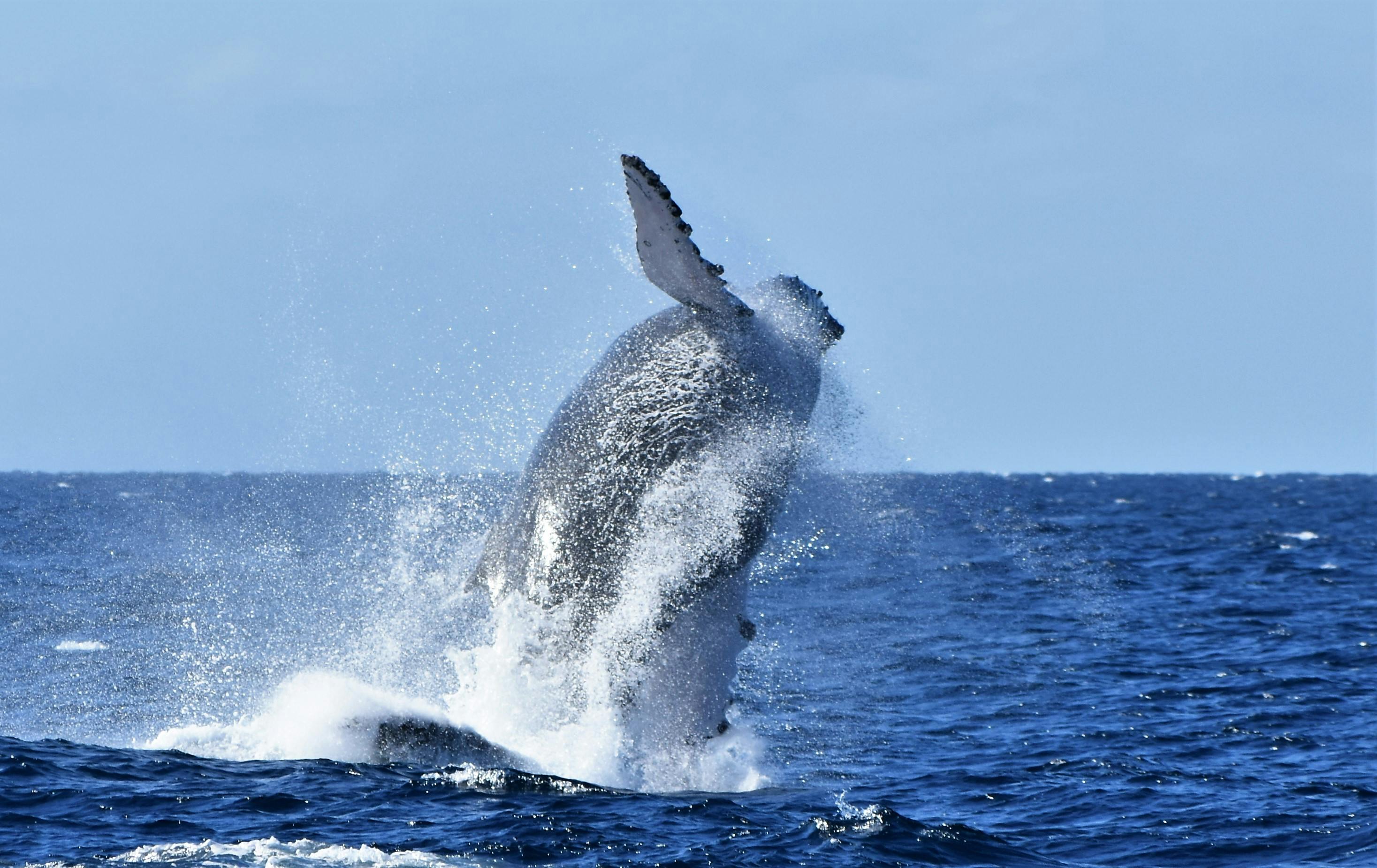
The waters off the Southern Pacific coast of Costa Rica are extraordinary. Within 30 minutes of Vista Bendita, you can be on a boat watching humpback whales breach in the Pacific, surrounded by dolphins, with a chance of sea turtles, manta rays, whale sharks, and false killer whales depending on the season.
This corner of Costa Rica has something almost no other place on earth can claim: one of the longest whale watching seasons in the world, with two distinct humpback whale migrations that overlap for several months each year. If you time your visit right, this will be the best wildlife experience of your trip.
The Whales — What You Need to Know
Two Migrations, One Location
Uvita sits at a remarkable convergence point. Two separate populations of humpback whales — from opposite ends of the Pacific — both choose this stretch of Costa Rica’s coast for breeding and calving.
North Pacific Humpbacks (December – April) These whales travel from California, Oregon, Alaska, and British Columbia to breed in the warm tropical waters of Marino Ballena. January and February mark prime spotting opportunities for the North Pacific migration. If you’re visiting during the dry season, you have a genuine shot at seeing whales.
South Pacific Humpbacks (July – October) — The Best Season These whales travel all the way from Antarctica. They arrive in July and stay through October to mate and give birth, with August and September as peak months — especially famous for mother-calf pairs and breeding behaviors. This is the season to prioritize if whale watching is important to you. Sighting rates are highest and the chance of seeing mothers with calves is greatest.
Why this matters: A mother humpback and her calf staying close to the surface, the calf learning to breach — this is what people come from around the world to see. During peak season, tour operators report sighting success rates as high as 95%. Travl
The shoulder months (July, October, November–December) still offer good chances and smaller crowds. March and April are the tail end of the North Pacific season — possible but odds are lower.
| Month | Season | Odds |
| December (late) | North Pacific begins | Good |
| January – February | North Pacific peak | Very good |
| March – April | North Pacific tail end | Moderate |
| May – June | Gap between migrations | Low |
| July | South Pacific begins | Good |
| August – September | South Pacific peak ⭐ | Excellent |
| October | South Pacific tail end | Very good |
| November | Gap | Low |
The Annual Whale & Dolphin Festival — Uvita
Every year during peak season — typically the first week of September — Uvita hosts the Annual Whale and Dolphin Festival. During festival week, whale sighting chances are about as close to guaranteed as nature gets. The festival includes music, local food, conservation talks, and boat tours running all week. If you can time your stay around it, do it. Book accommodation and tour spots well in advance — it draws visitors from across Costa Rica and abroad. Scribble Maps
What Whale Behaviors to Watch For
Most guests don’t know what they’re seeing in the moment. Here’s what to look for so you can appreciate it in real time:
Blow / Spout — Usually the first sign a whale is nearby. A column of mist shooting 3–4 meters into the air. When your guide says “blow at 10 o’clock” this is what they mean. Start tracking.
Breach — The dramatic one. The whale launches its full body out of the water and crashes back down. Nobody knows exactly why they do it — communication, parasite removal, or possibly just because they can. If you see one, you’ll understand why people come from around the world for this.
Spy Hop — The whale rises vertically, head out of the water, and holds position for several seconds. It appears to be looking around. It’s as strange and wonderful as it sounds.
Pec Slap — The whale rolls and slaps a pectoral fin repeatedly on the surface. The fins on a humpback are up to 5 meters long. The sound carries for miles.
Fluke — The tail raised high before a deep dive. This is the classic whale photo — tail silhouetted against the sky. It signals the whale is going down for a while, so enjoy the view and reset your camera.
Logging — The whale floating motionless at the surface, resting. Less dramatic but strangely moving — a 40-ton animal just lying still in the Pacific.
Photography tip: Use burst mode. Keep your camera pointed just ahead of where the whale surfaced last. Don’t zoom all the way in or you’ll miss the breach entirely — a wide shot of a full breach is far more satisfying than a tight shot of a splash.
Shore Watching — The Free Option
Shore watching from the Whale’s Tail or the beach at Marino Ballena costs nothing beyond the $6 park entry fee. During August and September peak season, whales are frequently visible from the beach and the Whale’s Tail sandbar itself — breaching, fluking, and spouting offshore.
This is a legitimate option for guests with young children who can’t manage a boat tour, anyone prone to sea sickness, or guests who simply want a quiet morning on the beach with a real chance of a whale sighting. Bring binoculars. Walk the Whale’s Tail at low tide and scan the horizon — you may not need a boat at all.
Swimming With Whales
Worth addressing directly because guests often ask. Costa Rican regulations prohibit swimming with humpback whales. They weigh between 15 and 30 tons and even a small movement could cause serious injury. Any operator offering in-water whale encounters is not operating legally — avoid them.
The closest legitimate alternative is the bioacoustic experience offered by Freediving Uvita — hydrophones deployed in the water let you hear the whales singing from the boat. Listening to a humpback vocalize while watching it surface 50 meters away is an experience that doesn’t require being in the water with it.
What If You Don’t See Whales?
It happens — rarely in peak season, more often in shoulder months. Ask your operator about their no-show policy before booking. Most reputable operators offer a partial credit or return trip if no whales are spotted. Freediving Uvita, Bahia Aventuras, and Whale Watching Uvita all have established policies — confirm before you pay.
Even on a “no whale” day, you will almost certainly see dolphins, sea turtles, manta rays, and spectacular coastal scenery. Guests who go out in May or June — outside whale season — regularly report extraordinary dolphin encounters that rival anything they’d hoped to see. The ocean here is never empty.
Our Recommendation — Freediving Uvita
We’ve been out with several operators and Freediving Uvita is the one we recommend without hesitation. They offer an exceptional whale watching experience in small groups with expert local guides, including searching for whales, dolphins, sea turtles, and caves with snorkeling depending on visibility. During whale season they deploy hydrophones so you can hear the whales singing underwater while watching them surface — an experience found nowhere else in the region. Apple Maps
They also run freediving courses, Caño Island expeditions, and spearfishing charters — a full ocean operation run by people who live in the water.
Book at: freediving-uvita.com
Other Reputable Operators
Bahia Aventuras — One of the most established operators on this coast, based in Uvita and operating in Marino Ballena National Park since 2007. Strong track record, bilingual guides, good for families. Also runs Caño Island and Corcovado day trips.
Whale Watching Uvita — Family-owned and operated for over 30 years, claiming the highest spotting rate in Uvita at 95% in peak season. Consistently outstanding reviews. Guides described as exceptionally knowledgeable and personable.
Ballena Tour Costa Rica — Certified eco-tourism provider running 3-hour eco-cruises from Uvita through Marino Ballena with naturalist guides covering whale and dolphin watching plus snorkeling at coral reefs. Also runs Caño Island, Corcovado, mangrove, and night wildlife tours.
Dolphin Tour Costa Rica — Well-reviewed operator combining whale watching with Caño Island diving and Corcovado day trips. Particularly strong reviews for guides’ contextual knowledge and professionalism.
Coral Expeditions Costa Rica — Departs directly from Uvita beach and includes the marine caves at Playa Ventanas, Whale Island, and the Whale’s Tail sandbar as part of the tour route. Good option for combining whale watching with coastal scenery in a single trip.
Osamar Adventures — A local Uvita operator running small-group whale watching tours with expert local guides. Tours include searching for whales, dolphins, sea turtles, and the sea caves at Playa Ventanas, with snorkeling depending on conditions. We’ve been out with them personally and recommend them without hesitation. Books through GetYourGuide — reserve in advance during peak season.
What to Expect on a Tour
Most tours run as follows:
Duration: 3–4 hours, departing in the morning (usually 7–8AM)
Departure: Directly from Marino Ballena National Park beach — a wet launch meaning you wade to the boat. Expect to be knee-deep maximum. Wear quick-dry clothes.
What’s included: Bilingual naturalist guide, life jackets, national park entrance fee, snorkeling stop (conditions permitting), fresh fruit and drinks
Cost: $75–$120 USD per person depending on operator, group size, and season. Private tours available at higher rates. Children under 9 years typically half price.
What to bring: Swimsuit, quick-dry clothes, reef-safe sunscreen, hat, waterproof bag for your phone, motion sickness medication if prone (the Pacific can be lumpy), binoculars
Regulations: All legitimate operators follow strict Costa Rican environmental guidelines — boats must maintain a minimum 100 meters from whales. No touching, no feeding, no chasing. This actually results in better sightings as whales approach on their own terms.
Beyond Humpbacks — Other Marine Mammals
The waters around Marino Ballena are home to much more than seasonal whales. Many of these can be encountered year-round.
Dolphins — Year-Round
Spotted dolphins, spinner dolphins, and bottlenose dolphins are year-round residents in these waters and appear frequently on boat tours. Dolphin sightings are extremely common on any whale watching tour and many guests find them equally memorable. Pods of hundreds have been reported in these waters — a surrounding mass of dolphins riding the bow wave is something you don’t forget.
Other Whale Species
The humpback is the headliner, but these waters support a diverse whale community. None are guaranteed, but all have been confirmed in the Marino Ballena / Golfo Dulce region.
False Killer Whales (Pseudorca crassidens) — Not actually whales but the largest members of the dolphin family. Fast, highly social, and they frequently approach boats with curiosity. Pods can number in the dozens and an encounter is considered one of the most extraordinary bonus sightings on any tour.
Pilot Whales — Seen intermittently year-round in the Southern Pacific. Travel in large, tight-knit social pods and are recognizable by their bulbous foreheads and slow, deliberate surface behavior.
Bryde’s Whales (Balaenoptera brydei) — A year-round resident medium-sized baleen whale that feeds on fish and krill close to the surface. One of the few whale species with a chance of encounter even outside the two main migration seasons.
Orcas — Rare but confirmed sightings occur in the Southern Pacific. An orca encounter in these waters is an exceptional event.
Blue Whales — The largest animals on earth, occasionally spotted in these waters though uncommon. A sighting here is a once-in-a-lifetime event that sends even experienced guides into barely contained excitement.
Sea Turtles
Four species of sea turtles are found in these waters — green, hawksbill, leatherback, and olive ridley. Regularly spotted from boats year-round, surfacing for air near reef systems. If you snorkel at Caño Island, an underwater encounter with a sea turtle is very likely.
Whale Sharks
Occasionally encountered in these waters, particularly around Caño Island during the green season (May–November) when plankton concentrations are highest. Completely harmless filter feeders — the largest fish in the ocean. A sighting is not guaranteed but not rare either.
Manta Rays & Eagle Rays
Both species are resident in these waters and commonly seen on Caño Island dives and snorkel trips. Manta rays with wingspans of up to 5 meters gliding silently below the boat is a genuinely humbling experience.
Caño Island — The Marine Wildlife Epicenter
If whale watching is the headline act, Caño Island Biological Reserve is the supporting cast that steals the show. Located about 20km offshore — roughly 90 minutes by boat from Uvita — it is consistently rated one of the best dive and snorkel sites in the Pacific.
Underwater visibility regularly exceeds 20 meters. You will see whitetip reef sharks, schools of jack, eagle rays, moray eels, hawksbill turtles, and dense coral gardens. In season, humpbacks pass through the area. Whale sharks appear here more predictably than anywhere else on this coast.
A Caño Island day trip is a full commitment — early departure, 3+ hours of boat time, a full day out — but guests who do it consistently rate it as the highlight of their entire Costa Rica trip. Freediving Uvita, Bahia Aventuras, and Ballena Tour Costa Rica all run Caño Island trips.
Planning Your Visit Around Marine Wildlife
July – October: Book your trip specifically for this window if possible. South Pacific humpbacks with calves, peak dolphin activity, whale shark season at Caño Island, and the lush green jungle of the rainy season as a backdrop. This is the best overall marine wildlife window of the year. The first week of September coincides with the Whale & Dolphin Festival — the single best week of the year to be in Uvita. Book everything well in advance.
December – April: North Pacific humpbacks plus the dry season’s calm seas make for excellent boat conditions. Good whale watching with the most comfortable weather. Caño Island visibility is at its best December–May.
Year-round: Dolphins, sea turtles, rays, and occasional false killer whale and pilot whale encounters can happen any month. Even outside whale season, a morning boat tour in Marino Ballena is worth doing.
Practical Notes
Book ahead. Peak season tours — especially August and September — fill days or weeks in advance. Don’t assume you can walk up the day before.
Morning departures only. All serious operators depart in the morning. Ocean conditions on the Southern Pacific deteriorate through the afternoon. Any operator offering afternoon whale watching tours is not worth your time.
Motion sickness. The Pacific swells can be significant, especially July–October. Take medication the night before and morning of. Don’t let this stop you — it is genuinely worth it.
Distance from Vista Bendita. Most operators depart from Uvita — about 25–30 minutes from Vista Bendita. Plan to leave by 6:30AM for a 7AM departure.
No-show policy. Ask your operator what happens if no whales are spotted before you pay. Most reputable operators offer a partial credit or return trip. Confirm in writing.
Wet launch. You will wade to the boat from the beach — knee-deep at most. Wear quick-dry clothes or a swimsuit. Waterproof sandals are ideal. Don’t wear anything you’d be upset getting wet or sandy.
Questions about booking or timing your visit around whale season? Leave a comment or contact us directly — we’re happy to help plan your marine wildlife experience.
Stay at Vista Bendita
After a day exploring waterfalls, beaches, whale watching tours, restaurants, and rainforest adventures, relax in the peaceful mountain setting of Vista Bendita overlooking Costa Rica’s South Pacific coast.
Enjoy ocean views, tropical wildlife, a private pool, and easy access to some of the region’s best experiences near Ojochal and Uvita.
More Details & Local Travel Tips
We’ve created a growing collection of travel guides, local recommendations, and insider tips to help you make the most of your stay at Vista Bendita and your time exploring Costa Rica’s South Pacific coast.
Browse our blog for information on:
- Restaurants and cafes in Ojochal & Uvita
- Beaches, waterfalls, and national parks
- Whale watching, snorkeling, and outdoor adventures
- Shopping, grocery stores, and local markets
- Travel tips, driving advice, and packing recommendations
- Wellness, relaxation, and hidden local gems
Whether you’re planning your itinerary or simply looking for inspiration after you arrive, our guides are designed to help you experience the region like a local.
Explore the Vista Bendita Travel Blog
Leave a Reply