
From the deck at Vista Bendita, the Pacific is the first show of the evening.
The sun drops toward the water. The jungle darkens behind you. The cicadas start up. The pool lights glow. And then, little by little, the sky becomes part of the view.
Most guests come for the ocean, the privacy, the pool, the wildlife, and the feeling of being tucked into the hills above Ojochal. But one of the quiet surprises of Vista Bendita is what happens after dark. The same west-facing view that makes sunset so beautiful also gives you a front-row seat to the evening sky over Costa Rica’s South Pacific coast.
This is not an observatory. You do not need to know astronomy. You do not need a telescope. You just need a clear night, a dark terrace, and a few minutes for your eyes to adjust.
Quick tip: Face the Pacific. Turn off unnecessary lights. Let your eyes adjust for 15–20 minutes. Then start with the brightest stars and planets.
Where to Look From the House
Vista Bendita faces west toward the Pacific.
That matters. Many generic star charts are drawn for the whole sky, but that is not how you experience the night from the house. The hills rise behind the property, so the best stargazing from Vista Bendita is the sky in front of you: the western, southwestern, and lower southern sky over the ocean and coastline.
- Face the Pacific.
- Sunset is straight ahead.
- Southwest is down the coast toward the Osa Peninsula.
- Northwest is back toward Uvita and Dominical.
- The southern sky is where some of the most interesting Costa Rica targets appear.
If you are visiting from the United States, Canada, or Europe, this southern view is one of the best parts. Costa Rica sits far enough south that guests can see objects that are difficult or impossible to see well from much of North America.
How to Stargaze at Vista Bendita
Print out a Monthly Guide to the stars at Vista Bendita.
The easiest routine is also the best one.
After dinner, turn off unnecessary lights, step outside, and give your eyes 15–20 minutes to adjust. Bright phone screens and white flashlights reset your night vision, so use a red-light setting if you have one.
Then start with the brightest things. Look for the Moon if it is up. Look for Venus, Jupiter, or Saturn when they are in the evening sky. Find the brightest stars first. Once your eyes adjust, fainter stars and the soft glow of the Milky Way become easier to see.
A simple pair of binoculars is perfect here. They are easier than a telescope, work beautifully from the deck, and make star clusters and Milky Way regions much more impressive.
Do not give up too early.
In the green season, the sky may look hopeless at sunset and then quietly open later in the evening. If the stars are not out at 7:00, check again at 9:00.
Check Tonight’s Sky Conditions
Before you head outside, check a stargazing forecast for Ojochal.
These tools can help you see cloud cover, moonlight, humidity, and the best clear-sky window for the night.
- Clear Outside Stargazing Forecast — designed for astronomers, with hourly cloud and weather forecasts.
- ClearSkys Stargazing Forecast — gives a simple stargazing score and highlights the clearest viewing window.
- Meteoblue Weather for Ojochal — useful for local clouds, rain, radar, satellite, and sunshine-hour forecasts.
Vista Bendita tip: In green season, check again later.
A cloudy sunset can still turn into a clear sky after 8:30 or 9:00 pm.
Month-by-Month Night Sky Guide
January — Orion Over the Pacific
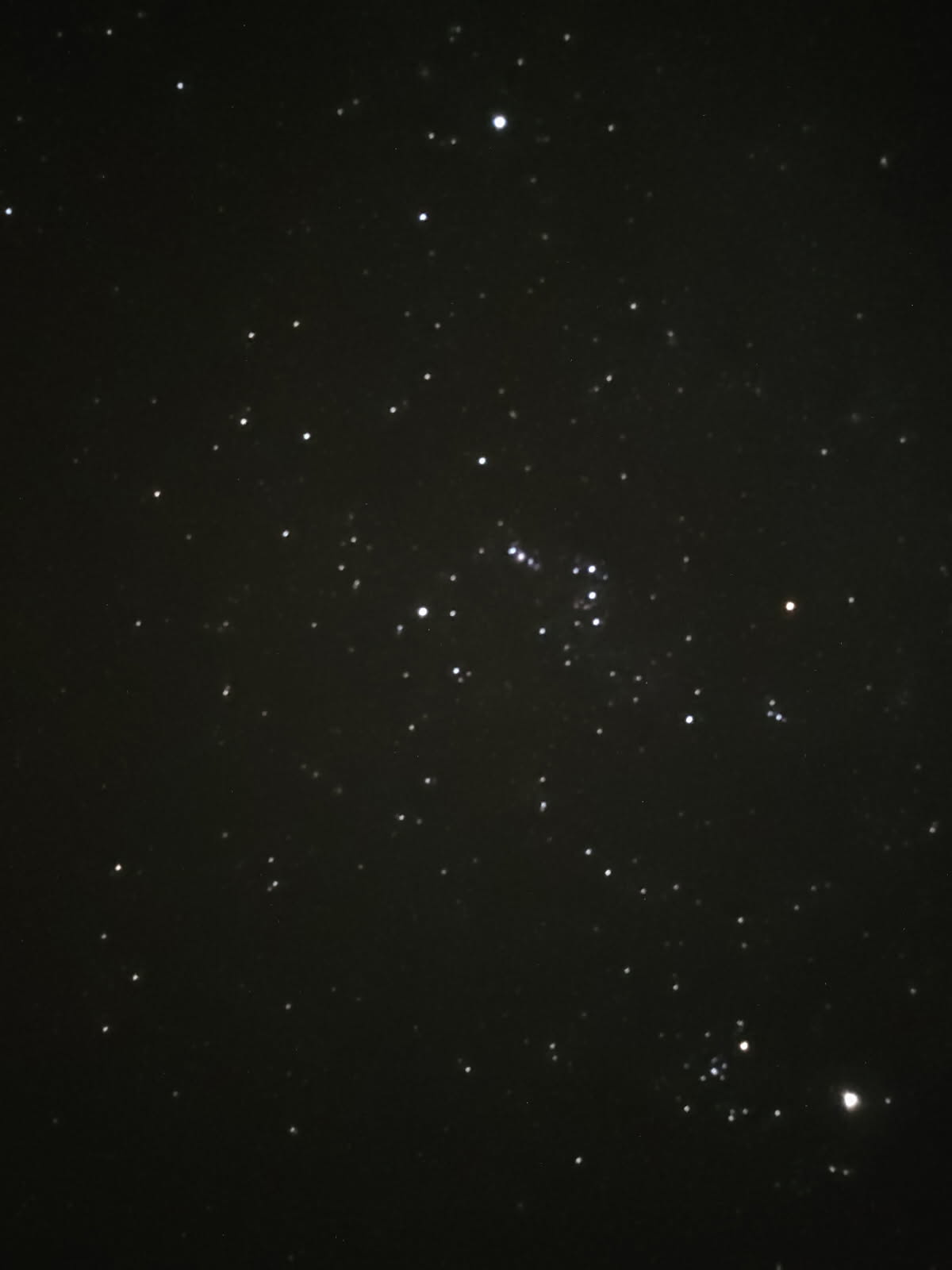
January is one of the easiest months for stargazing at Vista Bendita. Orion is the anchor. Look for the three bright stars of Orion’s Belt, then follow the line down toward Sirius, the brightest star in the night sky.
The Pleiades are also beautiful in binoculars. They look like a tiny dipper or a small cluster of blue-white sparks.
Our pick: Orion sinking toward the Pacific after dinner.
February — Bright Stars and Southern Hints
February still belongs to the bright winter sky. Orion, Sirius, and Gemini are easy targets for beginners.
If the southern horizon is open, look low toward the south for Canopus. It is one of the brightest stars in the sky and a special treat for guests from farther north,
where it is often hidden below the horizon.
Our pick: Seeing Sirius and Canopus on the same night.
March — The Southern Sky Begins
March is a transition month. The familiar winter constellations begin to move west earlier, and the southern sky becomes more interesting.
This is when you can start watching for the Southern Cross later in the evening. It will be low, so patience and a clear southern view help.
Our pick: First Southern Cross attempt of the year.
April — Southern Cross Season
April is one of the best months for southern-sky targets from Costa Rica.
The Southern Cross is the headline. It sits low toward the south, so it is not always obvious at first glance. Once you find it, though, it becomes one of those travel memories that feels tied to place.
With binoculars, try for Omega Centauri, a bright globular cluster and one of the great treasures of the southern sky.
Our pick: The Southern Cross from the deck.
May — Green Season Begins
May can be cloudy, but it can also be beautiful. This is the month when the sky starts to feel more tropical: warm, humid, dramatic, and changeable.
Scorpius begins to rise into better evening position. The Southern Cross is still worth watching low in the south.
Our pick: Scorpius appearing after evening rain.
June — Milky Way Season Starts
June is when the sky gets exciting.
Scorpius and Sagittarius move into prime evening position, and the bright central region of the Milky Way becomes a realistic target on dark, clear nights. Look toward the south and southwest.
The red-orange star Antares marks the heart of Scorpius. Sagittarius contains the famous “Teapot” shape and points toward the center of the Milky Way.
Our pick: The first Milky Way photo attempt of the season.
July — The Big Milky Way Month
July is the month to be patient.
If the sky clears, this can be one of the most memorable astronomy months at Vista Bendita. The Milky Way core is well positioned in the evening sky, and the south-to-southwest view can be excellent.
Use a tripod for photos. Even a phone in night mode can surprise you if it is held steady.
Our pick: Milky Way over the Pacific-facing deck.
August — Late Summer Milky Way
August keeps the Milky Way in play. The best view shifts earlier, so do not wait too late if the sky is already clear.
This is a good month for binoculars. Sweep slowly through the Sagittarius region and look for dense star fields, dark lanes, and bright clusters.
Our pick: Binoculars on the Milky Way from a lounge chair.
September — Short Windows, Big Rewards
September requires flexibility. It may not be the easiest stargazing month, but clear breaks can be dramatic because the air feels washed clean after rain.
Sagittarius and the summer Milky Way are still visible early in the evening, moving lower toward the west.
Our pick: A short clear break after a rainy evening.
October — The Quiet Sky
October is not the most reliable astronomy month, but it has its own mood. The sky is quieter, the nights are lush, and the jungle sound can be incredible.
Look for Fomalhaut low in the southern sky. It is sometimes called the lonely star because it sits in a relatively empty-looking part of the sky.
Our pick: Fomalhaut low over the Pacific.
November — The Sky Starts to Change Back
November begins the return toward the dry-season sky. Pegasus is prominent, and the Pleiades return to the evening.
This is a good month for relaxed, casual stargazing. The dramatic Milky Way season is fading, but the clearer winter patterns are beginning.
Our pick: Pleiades with binoculars.
December — Orion Returns
December is a great guest month. The skies often improve, the evenings feel festive,
and Orion returns to the night.
For many visitors, this is the easiest constellation to recognize. Once Orion is back, the night sky feels familiar, even in a place as wild and tropical as Costa Rica.
Our pick: Orion rising over the jungle and ocean.
Best Things to Find First
Easy Naked-Eye Targets
- Orion — best December through March
- Sirius — the brightest star in the night sky
- Pleiades — a small sparkling cluster, beautiful in binoculars
- Southern Cross — best March through May
- Scorpius — best June through August
- Sagittarius — points toward the Milky Way core
- Venus — brilliant when visible after sunset
- Jupiter and Saturn — excellent when they are in the evening sky
Binocular Favorites
- Pleiades
- Omega Centauri
- Milky Way star clouds
- Sagittarius region
- Bright clusters near Scorpius
A telescope is nice, but binoculars are often better for guests. They are simple, portable, and perfect for wide-field views over the Pacific.
Camera Tips From the Terrace
Phone cameras are surprisingly good at night if you keep them still.
- Use a tripod or brace the phone on a table or railing.
- Turn off the flash.
- Use night mode.
- Tap to focus on the sky.
- Lower the exposure slightly if the sky looks too bright.
- Include part of the deck, pool, palm trees, or ocean horizon for context.
- Try again. Night photography usually takes a few attempts.
For Milky Way photos, plan around the new moon and try June, July, or August
when the core is best placed in the evening sky.
Night Wildlife While You Stargaze
Do not only look up.
The rainforest around Vista Bendita is very much alive after sunset. While you are watching the sky, listen for the night.
- Geckos hunting near lights
- Bats crossing the pool area
- Tree frogs after rain
- Fireflies in green season
- Owls calling from the trees
- Cicadas and night insects
- Occasional mammals moving through the canopy
Use a red flashlight when possible, keep your distance from wildlife, and avoid shining bright lights directly at animals.
What About the Beach at Night?
A moonlit beach walk can be beautiful, but the beach is a different environment at night.
Tides, surf, rocks, river mouths, wildlife, limited lighting, and park access rules all matter. Avoid swimming at night. Check tide and access conditions before you go.
When in doubt, go with a local guide.
For photography, Playa Ventanas, Playa Tortuga, and the Marino Ballena area can be beautiful when conditions are safe and legal access is available.
For stargazing alone, the best and easiest place is often still the terrace at Vista Bendita.
No drive. No parking. No flashlight logistics. Just the view.
Our Picks
Best Beginner Constellation
Orion
Bright, easy to recognize, and visible during some of the clearest months.
Best Southern-Sky Target
The Southern Cross
A true Costa Rica travel moment for guests from farther north.
Best Milky Way Month
July
When the sky clears, this is the month with the biggest payoff.
Best Binocular Object
Omega Centauri
A spectacular southern globular cluster and a great reason to pack binoculars.
Best Photo Idea
Milky Way or bright planets over the Pacific-facing deck.
Best Stargazing Routine
Turn off the lights, pour something cold, sit quietly for 20 minutes, and let the sky slowly appear.
Leave a Reply