
You can spend a small fortune on wildlife tours in Costa Rica — and some are absolutely worth it (see our Corcovado and Caño Island posts). But here’s a secret we tell every guest: some of the best wildlife watching of your whole trip will happen with a coffee in your hand, in your pajamas, without leaving the deck.
Vista Bendita sits in the rainforest hills above Ojochal, in one of the most biodiverse regions on the planet. The South Pacific has Costa Rica’s highest wildlife concentrations — and a lot of it comes to you. Here’s your field guide to the show.
Birds: The Headliners
We’ve confirmed close to 70 bird species right at Vista Bendita, and the morning chorus from the terrace is something guests remember long after they leave. A few stars to watch for:
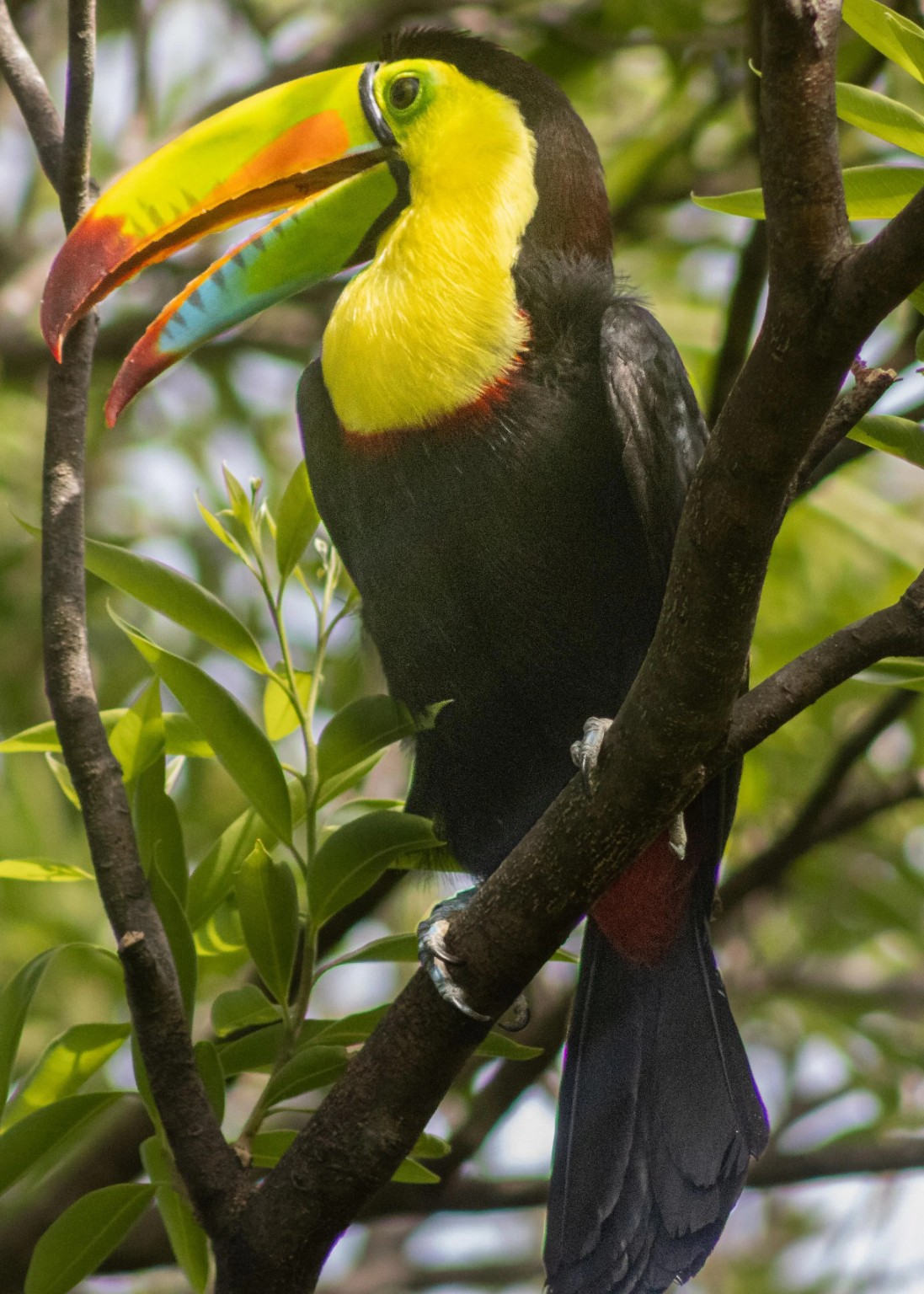
- Toucans — the chestnut-mandibled (yellow-throated) and fiery-billed araçari are both around. That improbable rainbow bill bouncing through the canopy never gets old.
- Scarlet macaws — yes, really. These spectacular red-blue-yellow parrots have been expanding through the South Pacific, and pairs fly over this coast with their unmistakable squawk. (We love them so much they get their own post.)
- Tanagers, honeycreepers, and euphonias — jewel-colored little birds that flit through the trees, especially where fruit is ripening.
- Hummingbirds — several species, hovering and zipping at any flowering plant.
- Raptors — hawks and, overhead, vultures riding the thermals off the ridge.
Pro move: download the free Merlin Bird ID app from the Cornell Lab before you arrive and install the Costa Rica pack. Sit on the terrace in the morning and let it identify birds by their song in real time. It turns a pretty view into an active treasure hunt — and it’s how we’ve confirmed so many of our species.
Monkeys: The Comedians
Costa Rica has four monkey species, and this region is prime territory for several. Listen and look for:
- Howler monkeys — you’ll likely hear these before you see them: a deep, guttural roar that carries for miles and sounds far bigger than the animal making it. Dawn is their concert hour. The first time, it’s startling; by day three, it’s your favorite alarm clock.
- White-faced capuchins — the clever, expressive “organ-grinder” monkeys, often moving through the canopy in troops. Smart enough to raid a kitchen, so keep food secured.
- Squirrel monkeys (titi) — small, quick, and charming, traveling in lively groups (more localized, but a treat when they pass through).
- Spider monkeys — the long-limbed acrobats of the high canopy, more often seen on forest hikes than from the deck, but present in the region.
Sloths: The Local Celebrities
The most-requested animal in Costa Rica, and they’re around here — though they take a patient eye to spot. Both species (the brown-throated three-toed and Hoffmann’s two-toed) live in this region. They’re slow, camouflaged, and spend their lives high in the trees, so scan the canopy for what looks like a clump of leaves that’s slightly the wrong shape. They earned a whole post of their own — start there for how to actually find one.
The Supporting Cast
- Coatis — raccoon relatives with long, upright tails, often in foraging groups. (Fun fact: in reverse, they look like tiny dinosaurs.)
- Agoutis — large, leggy rodents that trot across the forest floor.
- Iguanas and lizards — everywhere and harmless; the little ones doing push-ups on the railing are a daily comedy.
- Geckos — your nightly bug patrol; welcome them.
- Butterflies — including the electric-blue morpho, which flashes like a piece of falling sky.
- Frogs — the green season brings a chorus, and with luck, colorful little tree frogs.
- Hermit crabs and, near the beaches, more — the whole coast is alive.
A gentle note: this is the tropics, so there are also things with more legs than you’d like. They’re part of a healthy ecosystem, almost always harmless, and easily managed with a little awareness and some insect repellent.
How to See More: A Terrace Safari Guide
The wildlife is here. Seeing it is mostly about when and how you look:
- Go early. The hour after dawn is the single best window — coolest, and animals are most active. Be on the deck with your coffee by 6 AM at least once.
- And go late. Dusk brings a second shift change: birds settle, then the night sounds and fireflies begin.
- Be still and quiet. Wildlife comes to calm. Put the phone down, stop talking, and just watch the tree line for movement.
- Look up, and look for the wrong shape — a lump in a branch, a tail, a flicker.
- Listen first. Howlers roaring, macaws squawking, leaves rustling — sound tells you where to point your eyes (and the Merlin app).
- Use binoculars. Pack a pair; the canopy is high and a zoom changes everything. (No flash on the sloths and night animals, please — see our mindful traveler guide.)
- Never feed anything. A fed monkey or coati becomes aggressive and unwell. Watch, don’t snack-share.
The Best Part
There’s no schedule and no ticket. You’ll be reading by the pool when a troop of capuchins passes overhead, or sipping wine at sunset when a pair of macaws cuts across the gold sky. The show runs all day, every day, and the deck is the best seat in the house. That’s the blessed view — it’s alive.
Spotted something great from the deck during your stay? Tell us what and when in the comments — it helps us keep the species list growing.
Stay at Vista Bendita
After a day exploring waterfalls, beaches, whale watching tours, restaurants, and rainforest adventures, relax in the peaceful mountain setting of Vista Bendita overlooking Costa Rica’s South Pacific coast.
Enjoy ocean views, tropical wildlife, a private pool, and easy access to some of the region’s best experiences near Ojochal and Uvita.
More Details & Local Travel Tips
Browse our blog for information on:
- Wildlife & bird watching
- Caño Island snorkeling & diving
- Whale watching & marine wildlife
- The mindful traveler’s guide
Explore the Vista Bendita Travel Blog
Leave a Reply